
Part 3: Hearing Examiner Ruling: How Best Available Science Disappeared from the Avista Decision
- Amy O.

- Jan 13
- 8 min read
Other Related Posts: Part 1: Quick Overview / Why it matters / What Council can do / What you can do
Takeaway: Ruling does not accept best available science and best management practices from credible experts, County engineering reports, UW research and state regulatory agencies
Part 3: Factual error made in the Ruling about Appellant Exhibit Admissions
Backdrop: Dispelling and Dismissing Evidence
The Ruling covers the confusion over the timing and format of the Appellant’s exhibits (pp. 8-10). During the hearing, there were two motions made by the attorney teams to dismiss the Appellant’s exhibits. Preceding the hearing in summer, the City stonewalled the Appellant's record requests, resulting in a PRA lawsuit (Read evidence in Community Report). The Avista transcript also reflects repeated objections and interruptions over exhibit handling. .
This is partly why the Hearing Examiner pushed the parties toward a citation-based exhibit approach rather than taking hours to walk through every Appellant exhibit live.
Authorized Cure Path for Exhibits Created by Examiner and then Disregarded
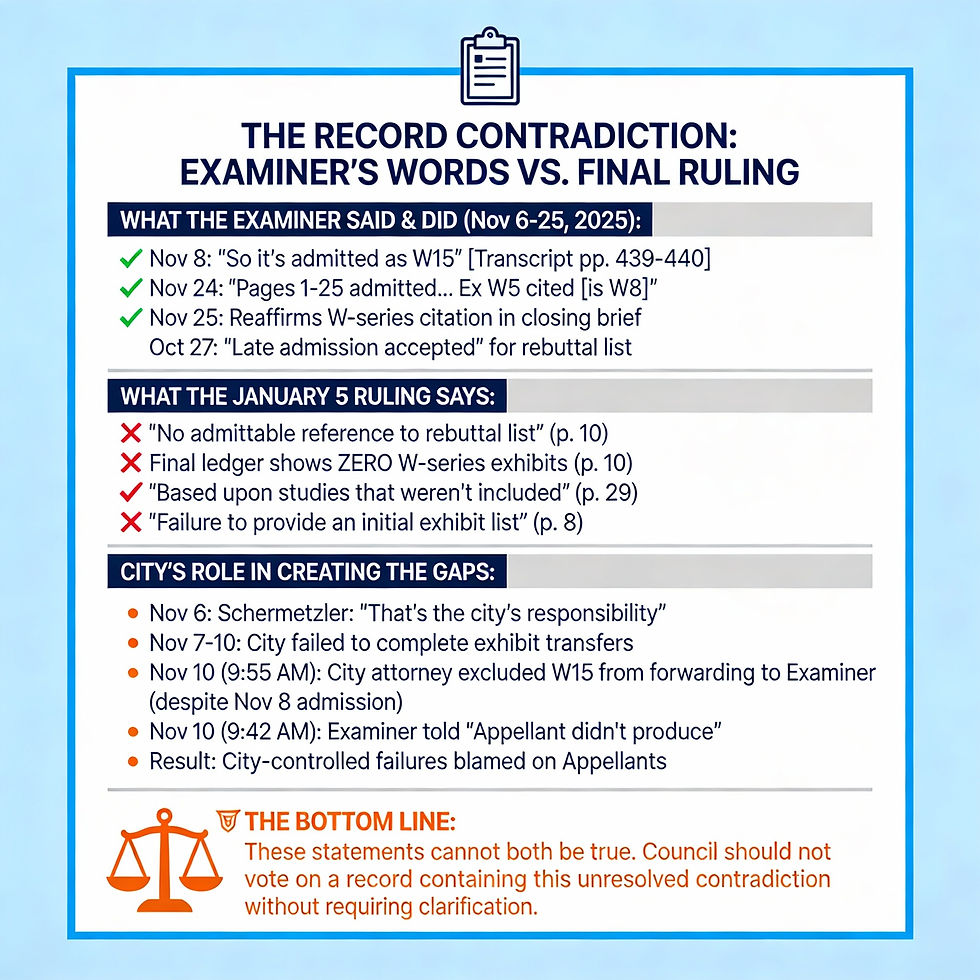
The chronology below documents how the Hearing Examiner created a cure pathway for web‑based exhibits, acknowledged at least one W‑series citation in the closing brief, and later issued a Ruling stating Appellants made "no admittable reference" to their exhibit list, a statement that directly conflicts with the Examiner's own transcript admission of W-15 and his November 24-25 emails recognizing W-series citations in the admitted closing brief.
Chronology: Findings of Fact
Oct 4, 2025: Discovery Order
Following ongoing disputes over incomplete City production (including prior PRA litigation), the Examiner issues an Order Partially Granting Discovery, requiring the City to deliver all remaining Avista‑project documents by Oct 17, 2025, in addition to the permit record the City had already produced on September 26.
Oct 21–23, 2025: Late City Exhibit Additions
City adds Ex. 220–225 (CDS Director admits City "accidentally omitted" updated materials), signs Voluntary Mitigation Agreement (Ex. 232), and issues SEPA Appeal Staff Report (Ex. 230) one day before Appellants' deadline. Examiner allows these late exhibits, stating they will "not be excluded as untimely."
Oct 24, 2025: Appellants file no list, expecting to file what they believed was a rebuttal exhibit list on Oct 27. In the Ruling, the Examiner later labels this “Failure to provide an initial exhibit list.”
Oct 27, 2025 (6:48 PM): Examiner sends email stating "Late admission accepted" after the Sunday deadline. Appellants had submitted their rebuttal exhibit list with "W" website exhibits at 4:52 pm, and a "document room" access link email at 10:02 pm with W‑series web exhibits. The Examiner adopts the 10:02 pm list for numbering.
Image 7A: Oct 27, 2025, 6:48 PM, Olbrechts email and Document Room Link

Asymmetric Enforcement: The Examiner accepted the City's multi-day late additions (Oct 21-23) as "not untimely" while later characterizing the Appellant's one-day Sunday delay as "Failure to provide an initial exhibit list" (Jan 5 Ruling, p. 8) using it as the first procedural allegation against Appellants despite having accepted the late submission on Oct 27 with "Late admission accepted."
Nov 6–10, 2025: Examiner Creates Cure Path, City Fails to Execute Transfer
The parties adopt the “W” numbering convention; W‑15 is admitted on the record for stormwater probability evaluation. The Examiner then instructs Appellants to convert key W‑exhibits to PDFs and establish relevance by citing them in their closing brief, a specific cure path for the earlier link‑only problem.
Nov 6, 2025: City Attorney Demands Exclusive Record ControlCity Attorney Schermetzler argues:
"We need a clean record. We need to know what the exhibits are... That's the city's responsibility."— City Attorney Tim Schermetzler, Day 2 Transcript (Nov 6, 2025)
Hearing Examiner accepts this argument, ruling the City holds ultimate responsibility for record maintenance.
Nov 7, 2025 (3:00 PM): Appellants Upload PDFs to Shared Document Room
Appellants uploaded W-series PDFs to the shared document room as instructed by the Hearing Examiner. The City-controlled document room system required that these exhibits be transferred from the shared room to the official permit record for public posting and Examiner access.
Nov 8, 2025: Hearing Examiner Admits W15 on the Record
During hearing, Examiner states regarding 2025 Whatcom Future Shorelines Report:
"This document's going to be admitted for the limited purpose addressing the accuracy of assessing stormwater probability so it's admitted as W 15."— Hearing Examiner, Transcript pp. 439-440
Nov 10, 2025 (9:42 AM): Examiner States PDFs Not Received:
The Hearing Examiner emailed stating: "Mr. Pointer did not contain pdfs," indicating he had not received the PDF files as email attachments or in his official record materials.
Nov 10, 2025 (9:55 AM): City Attorney Fails to Forward All Appellant Exhibits
City attorney (CSD Law) forwards some Appellant exhibits (W5A/W5B) to the Hearing Examiner while excluding others (W15), despite W15 having been admitted in the Nov 8 hearing transcript. These are City-controlled failures to provide all Appellant documents, yet the ruling attributes them to Appellant "non-compliance."
Nov 10, 2025 (10:10 AM): Appellant replied to the 9:42 AM Examiner email with screenshots and timestamps proving the November 7 upload to the shared document room, stating:
"The City did not move our exhibits into their document room. We cannot be responsible for the City's untimely posting of our PDFs." — Appellant email (Nov 10, 2025)
This exchange shows a gap: Appellants uploaded files on Nov 7 (documented by timestamp/screenshot), but by Nov 10 morning, the Examiner had not received them. The discrepancy is whether the City's document room system completed the transfer from shared access to official record.
Nov 19, 2025: Appellants Submit Remedied Closing Brief
Appellants submitted their Remedied Closing Brief (pages 1–25), which references multiple W‑series exhibits, including W5, W‑8 (UW Climate Impacts Group precipitation data), and W‑15 (Whatcom Future Shorelines Report). However, on November 24, the Examiner's email acknowledged only one exhibit citation: "The only BWC exhibit cited in the BWC closing brief was Ex. W5, which appears to actually be Ex. W8 in BWC's exhibit list." This discrepancy between the exhibits Appellants referenced in the brief and which citations the Examiner recognized is part of the exhibit-numbering confusion Council should clarify.
Nov 24, 2025 (2:27 PM): Examiner Admits Brief and Acknowledges W5/W8
Examiner emails:
"Pages 1–25 of the remedied BWC closing are admitted as well as Ex W5. Pages 29–49 are not admitted. The only BWC exhibit cited in the BWC closing brief was Ex. W5, which appears to actually be Ex. W8 in BWC's exhibit list."
Nov 25, 2025: Examiner Reaffirms and Creates Final Opportunity
Examiner emails referencing "As previously ruled yesterday at 2:24 pm..." and gives final opportunity for rebuttal exhibits with relevancy explanations.
Jan 5, 2026: Ruling States "No Admittable Reference"
The January 5 Ruling states Appellants made "no admittable reference to their rebuttal list in their closing argument," and no W‑series exhibits appear in the final admitted‑exhibits ledger (Ruling, p. 10).
Take away:
The January 5 Ruling's statements about Appellants’ exhibits are not just incomplete, they directly conflict with the Examiner’s own transcript admission of W‑15 and his November 24 email recognizing a W‑series citation (W5/W8) in the admitted closing brief. Also, inconsistent W-series numbering across different lists creates confusion about which documents correspond to which exhibits.
City of Blaine Council should require an exhibit-admission ledger clarifying what was tendered, admitted, and excluded before voting.
The Details In his November 10, 2025 email, the Hearing Examiner stated that Mr. Pointer [Appellant] had not supplied the required PDFs in the form of email attachments, and he set a cure path:
“Mr. Pointer can just have the required pdfs referenced in his closing argument and supplied concurrently with that argument.” - November 10, 2025, 9:42 am, Olbrechts email
Image 7B: November 10, 2025, 9:42 AM, Olbrechts email

In the same email, the Hearing Examiner wrote that “Mr. Pointer was asked to supply pdfs of his web linked exhibits by 3 pm on 11/7. The list he sent me did not contain pdfs” The Ruling went on to later state the Appellants “didn’t produce the requested pdfs.”
However, the Appellant document room for Exhibits had been updated for access on Nov 7 given the number of documents and size could not be sent via email. The City attorney was responsible for moving exhibits into their "permit" of record. However this had not been done.
Image 7C: November 10, 2025, 10:10 AM email confirming upload of Appellant exhibits and City document room excluding these exhibits.

How did W5A and W5B from the Department of Ecology, admitted back in October 27, 2025 as part of the Appellant's Rebuttal Exhibits Disappear from the record?
In a November 10, 2025, 9:55 AM email to the Examiner, the City Attorney (CSD Law) included the W5A and W5B DOE Water Quality Atlas exhibits yet excluded the W15 Shorelines Report as evidence, even though the Examiner had asked during the November 8 hearing that W15 be included.
Image 7D: November 10, 2025 email CDS Lawyer (City attorney) list with missing Appellant Exhibits submitted

The Ruling does not mention the challenges with document room control by the City and where and how the PDFs were supplied for admission. It treats the absence of PDF attachments on November 7 as a failure by Appellants to “produce the requested pdfs,” without addressing Appellants’ claim and screenshots showing that the PDFs had been uploaded to the shared document room and were awaiting the City’s transfer into its own record system.
The November 19 remedied closing brief explicitly cited Exhibit W8 (UW Climate Impacts Group precipitation projections), and the Examiner’s November 25 email acknowledged that the only BWC exhibit cited in the closing brief was “Ex. W5, which appears to actually be Ex. W8 in BWC’s exhibit list.
Image 8: Email with Exhibits sent to Examiner for Closing Brief (previously provided in document room on 11.7.2025)

Exclusion of UW CIG Climate Data Exhibit W8
The W8 climate data exhibit was included according to the Examiner's 11.24.2025, 2:27 pm email. Image 9: November 24, 2025, 2:27 PM PDT email from Hearing Examiner to Appellant and parties of record (developer, developer attorneys, City attorney and Blaine Planning)

However, The Remedied Brief submitted on November 24, 2025 (~1:00 pm) on page 7 refers directly to this included UW exhibit data exhibit W8. Image 10: Appellant Remedied Closing Brief, p.7 mention of CIG and exhibit included

The Avista transcript also shows the Examiner admitting W15 for the limited purpose of evaluating stormwater probability assumptions (“it’s admitted as W 15”), so the record itself undercuts any suggestion that no W‑series exhibit was ever admitted.
Towards the Final Submission
Hearing Examiner’s Nov 24, 2025 email says something different. It admits pages 1 to 25 of the remedied closing brief, admits Ex W5, and then states:
“The only BWC [Appellant] exhibit cited in the BWC closing brief was Ex. W5, which appears to actually be Ex. W8 in BWC’s exhibit list.”
In the follow-up Nov 25, 2025 email, the Examiner explains why he created the citation‑based cure path and confirms that at least one exhibit citation was made:
Image 10: Hearing Examiner 11.25.2025, 3:08 pm PDT email with instructions for submission of exhibits in the Avista SEPA Appeal Appellant Brief (12.5.2025)

Compliance with Examiner Exhibit Requests
But Mr. Pointer [Appellant] had sent the exhibits on November 7, 2025 with a document room link and the City had not uploaded the Appellant’s exhibits. Some of the files were large and could not all be attached and sent by email.
Later that morning on November 10th, Appellant replied:
Stating, “I did as you asked at approximately 3 pm… I also provided all the PDFs in the document room simultaneously. See evidence in screen shot below.”
Showing screenshots of the Appellant’s secure cloud drive "Avista SEPA Appeal” folder showing the W‑series PDFs (W.1–W.8 and related files) present as static documents.
Explaining, “The City did not move our exhibits into their document room. We cannot be responsible for the City's untimely posting of our PDFs. We have been following the procedure of the document room with no objection raised to my knowledge.”
Issues of Fairness
Questions of Fairness Arise when Using Expert Data to Question the City and Developer.
During expert testimony, Avista's Cascade Engineering relied on background/derivative reports inside their own stormwater submission to explain away the infamous “809%” exceedance as “not Avista’s flow rates.” - Osborn report exhibit on downstream stormwater model failure for Rogers Slough. If the developer can rely on derivative/background materials to defend its assumptions, why did the Hearing Examiner and City disallow use of derivative/background best available science materials from experts and UW to challenge those same assumptions?
Is this fair? The process becomes a one-way filter that protects the project and disenfranchises the public.

Comments