

How City Planning Departments Skirt Compliance in Washington State (Part 1)
- Otto Pointer
- 13 hours ago
- 11 min read
How incomplete records, outdated standards, and procedural shortcuts move risky projects forward before the public ever gets a fair hearing.
Published in Whatcom Watch (April, 2026)
By Geoffrey Baker, MBA Healthcare, under the pseudonym Otto Pointer. Contributing Editors: Oliver Grah, CPWS, Tina Erwin, CDR USN (Ret.)
Part 1: A post-mortem covers front-end regulatory capture / compliance-skirting before and during the hearing process:
how planning departments use incomplete records, vesting, outdated standards, selective disclosure, and procedural narrowing to move risky projects forward;
how science gets constrained before the quasi-judicial appeal even starts;
why that matters for drinking water, flooding, wetlands, and downstream pollution.
In Part 2: How Quasi-Judicial Bias Makes Science Vanish. We apply e-discovery tools to investigate quasi-judicial bias during the hearing examiner hearings and ruling. Inside the Avista SEPA appeal: evidence exclusion, burden shifting, and a hearing process tilted toward the City and applicant.
Introduction
State Environmental Policy Act decisions are making headlines in Whatcom from Salish Sea LNG terminals to estuary protection (Mud Bay Cliffs). This story looks inside the City of Blaine’s land-use tactics during a three-month SEPA appeal in late 2025.
In January 2026, the Blaine City Council denied the citizen appeal and approved the 181-acre, ~$0.5 billion, 490-unit Avista at Birch Point development above and north of Birch Bay, one of the largest in Whatcom County today. Crucially, the City Attorney (CSD Law) framed the Council vote as a binary choice (approve or deny), effectively sidelining a formal request to admit missing evidence for council decision-making.
The appeal drew over 200 written comments, five days of testimony, and hundreds of pages of exhibits. Their top concerns: worsening flooding in Birch Bay Village, cumulative stormwater pollution impairing shellfish beds, wetland shrinkage, protection of Critical Aquifer Recharge Areas that keep the bay clean, frequently flooded areas, traffic, and shifting infrastructure costs onto existing homeowners through higher utility bills.
With so much tax revenue at stake, the city and developer (Semiahmoo LLC) spent thousands of dollars on a small army of 7 lawyers and paralegals to rebuff the “Pro Se” community volunteers (Appellants).
Tactic 1: Slow Walk Appellant Public Record Act (PRA) Requests; Fitful Start
Early on, the City of Blaine omitted or selectively posted Avista records (i.e., documents, public comments and communications on the website/ document center). When WPM Appellants filed the PRA request on July 18, 2025, to advance preparation efforts, the City clerk said it would take until August 27, 2027, almost 2 years beyond the hearing close date “to review 26,000 emails.” This appeared unreasonable and out of scope. Delays in PRA requests also disadvantaged citizens needing time to pour through technical documents and prepare evidence as the pre-hearing of October 2, 2025 approached.
Given these hurdles, the Appellants filed a Public Records Act (PRA) complaint in Whatcom County Superior Court (August 8, 2025). This was later withdrawn ( September 5, 2025) when the Hearing Examiner affirmed the challenges faced by the Appellants and ordered discovery on the City to overcome these “obstacles” (October 4, 2025). By October 15, 2025, the City had released over 100 previously withheld files, including important Department of Ecology (Ecology) concerns about frequently flooded areas, unmaintained ponds that flooded Birch Bay Village, disturbed and unprotected wetlands used for contaminated stormwater, polluted streams and project engineering correspondence.
Tactic 2: Vanishing Science
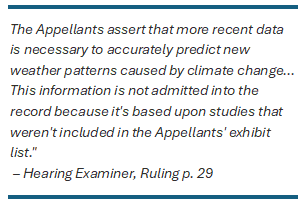
One of the clearest procedural failures in the Avista SEPA process involved the admission, exclusion and selective omission of evidence into the Hearing Examiner’ record for ruling on mitigating conditions for responsible development.
On Day 4 of the Avista appeal hearings (Nov. 12, 2025), an exchange occurred that would later drive a formal City Council remand request to restore admitted evidence, initiate state compliance and trigger a forensic audit of Blaine’s examiner and administrative record process for bias. In quasi-judicial rulings, only “admitted” evidence is considered. That is why disputes over exhibit status mattered: if climate, water-quality, or shoreline materials disappeared from the admitted record, they also disappeared from the decision-making framework.
It began with the Hearing Examiner considering whether to admit the Appellant’s 2025 Whatcom County Future Shorelines Report, a technical study as evidence. The report references the University of Washington Climate Impacts Group (CIG) projections for 100-year flood events in Birch Bay. These events are expected to increase dramatically by the 2040s and beyond with continued climate change.

CIG projections are vital for stormwater planning (3), used by seven large cities and counties in the state (4) to stress test stormwater frequency, intensity and duration events in hydrology models for stormwater ponds.
For example, Avista developer’s stormwater management plan is based on an outdated version of Ecology’s Western Washington Hydrology Model (WWHM 2012) assumptions for rain duration, frequency and intensity that do not account for climate change.
WWHM uses the 1948–2009 Blaine rain gage record, a 77-year historical dataset that predates more frequent and intense atmospheric rivers and flooding now hitting Whatcom County almost every year.
The Department of Ecology (Ecology) has recommended cities and counties use climate-adjusted multipliers for precipitation scenarios in WWHM even when cities like Blaine vest developers to lower standards (outdated stormwater manuals and pollution standards [AKART]).(1)

The risks of faulty or overly aggressive assumptions are not theoretical. If contributing water areas (frequently flooded areas, stormwater pond capacity, conveyance systems, wetland buffers, or forest cover are mischaracterized or miscalculated, the consequences flow directly downhill to Birch Bay. Homes in Birch Bay Village flood, property values decline, homeowners lose affordable insurance coverage (2), and shoreline recreation, shellfish harvesting, fishing and beaches become contaminated.
One of our exhibits for local Birch Bay CIG impact shows that the 100-year, 24-hour storm in the 2040s is projected to be approximately 31.7% more intense than the 1981–2010 baseline with some models projecting increases up to 78%.
The CIG analysis is one example of best available science (BAS) exhibits initially admitted as evidence then dismissed by the Examiner. This is not a peripheral matter. It goes to the core environmental questions SEPA is designed to address and directly contradicts Washington's "best available science" mandates for critical areas protection.

Tactic 3: Material Omission
Example 1: The Creek That Vanished from the Record. A key example of this bias-through-omission is the treatment of Wetland C on the Avista site, a hydrologically connected feature that drains into a state-listed 303(d) impaired, fish-bearing stream flowing into Birch Bay. Ecology maps showing this impairment were admitted into the record but vanished from the Examiner’s findings. Instead of applying stricter buffers and All Known, Available, and Reasonable Treatment (AKART) standards for polluted waters under RCW 90.48, the ruling treated the stream as a mere "private ditch," shrinking buffers from a potential 225 feet to just 95 feet; a 19.84-acre deficit that boosts buildable land for the developer. This omission wasn’t accidental; a remand letter flagging the maps was blocked from Council review, ensuring the correction never factored into the final decision.

Example 2: Best Available Science (BAS). The Examiner’s 58-page ruling is conspicuously silent on the City’s statutory duty to apply Best Available Science under RCW 36.70A.172 and Blaine’s own code (BMC 17.82.055). The phrase “best available science” appears zero times as an affirmative obligation that the City was required to meet. It surfaces only once when the Examiner uses it to discredit the Appellants and community citizens who testified, including a retired engineer familiar with historical flooding issues from unpermitted Avista ponds downstream from the project. Citizen letters about flooding from unpermitted ponds were also summarily dismissed.
Instead of enforcing this mandatory code, the Examiner used two procedural trapdoors to make science vanish:
The 'Vesting' Trap: He ruled the City was 'bound' to the 2019 Stormwater Manual because the application was vested, effectively ruling that bureaucratic dates trump the physical reality of climate change.
The 'Finality' Trap: He ruled that the Critical Areas Determination (CAD), which relied on outdated 1996 data, could not be challenged because it wasn't appealed earlier. This allowed a 'final' administrative decision to stand even though it violated the BAS code by ignoring modern aquifer maps.
By prioritizing 'Vesting' and 'Finality' over the BAS mandate, the Examiner created a legal loophole where the City is shielded from knowing what its own staff know.
When the Appellants’ certified wetland scientist highlighted best practices for this highly disturbed site, including ditches draining wetlands, historical clear-cutting, removal of 30–40 acres of red alder canopy, and construction of unpermitted ponds, the City Planning Director had clear authority to reopen the CAD under BMC 17.82.250(b) ….to investigate the documented concerns. He refused. Instead, the City and Applicant discounted Ecology's frequently flooding areas and wetlands concerns, used hearsay to dismiss Avista’s location in County CARA aquifer maps, and ignored an impaired creek deserving of protection for fish and lagoons in Birch Bay Village, primarily on procedural grounds, choosing to approve the project in a vacuum of missing facts and outdated city maps.
Tactic 4: Passing the Buck
Use Selective Framing and Plausible Denial to Exempt the Developer and City from Practicing Best Available Science

The Examiner’s ruling relies on Selective Framing: selectively omitting and conflating minimum code compliance with substantive safety. By arguing that because the 2019 Stormwater Manual (replaced already by 2024) doesn't force the City or Applicant to check for climate impacts, they cannot do so, the City creates an outcome of perceived compliance.
This ignores SEPA’s “Hard Look” and the City’s statutory duty under (WAC 197-11-660) and the Growth Management Act (RCW 36.70A.172) and the City’s own ordinances (BMC) to use Best Available Science (BAS) to prevent actual harm.
The City's & Examiner's Claims | The Reality & Legal Rebuttal |
I’m not “aware of any jurisdiction that has as yet attempted to impose more than required by its stormwater standards through SEPA on the sole basis of climate change.” Examiner Ruling, p. 3, footnote 3 | Incorrect. Multiple Washington jurisdictions already voluntarily use CIG climate data for stormwater planning (Thurston, King County and Tacoma) "Lack of awareness" is not a defense for ignoring BAS. WAC 197-11-080 requires obtaining essential risk info (e.g., flooding) if feasible. |
"WWHM time period cannot be modified... such modification lacks precedent."
Examiner Ruling, p. 28 | Incorrect. WWHM explicitly includes "precipitation multiplication factors" (0.8–2.0) for this purpose
Source: WWHM User Manual v4.3.2; SWMMWW Appendix III-B. The tool exists; the City of Blaine refuses to use it. |
For atmospheric river events, “once in a lifetime" and "designing for such events is not how we review stormwater."
City Planning Director, Staff Report, Oct. 2025 | Junk Science. Fails SEPA “Hard Look.” Climate change isn't an "outlier"; it’s a shifted baseline. Using 1948–2009 data designs for a climate that no longer exists, resulting in undersized infrastructure. The Director’s statements are directly contradicted by Whatcom County proactively planning for increased drainage flows; modeling 22% increases in waterflows from the Avista project basin.[i] |
“…the SEPA checklist does not reference ‘climate’ as …subject to SEPA review.”
City Public Works Director, Staff Appeal Report, Oct. 15, 2025 | Legal Misdirection. The SEPA Checklist is a floor, not a ceiling. Substantive Authority empowers the City to mitigate any proven adverse impact, regardless of a che |
This is classic framing that treats the vesting of the application to the 2019 Stormwater Management Manual as a legal shield against climate science. The City's vesting argument, in other words, may close the SEPA record, but it does not determine whether the approval meets best available science standards for state permitting purposes.
Tactic 5: Marginalize: Evidence Exclusion, Vanish, Discredit and Dismiss Process


What citizens experienced with the CIG/Shorelines exhibit exclusion happened repeatedly with procedural blockages and motions to deny exhibit admission. While we struggled under tight deadlines as “Pro Se” Appellants to get the right formats for submission, there was a larger pattern at play. Excluding evidence was not an isolated incident. There appeared to be concerted efforts by Applicant and City to exclude consequential information that might affect the buildable footprint or higher costs relating to mitigating flooding, pollution or wetlands damage risks.

Tactic 6: Signal A Future Judge with “Near Bullet-Proof” Case
"…despite the efforts to absorb thousands of pages of technical information within the compressed timeframes... the appellants could not overcome the near bullet-proof permit record compiled by City planning staff and the Applicant." Phil Olbrechts, Hearing Examiner, City of Blaine, Jan. 6, 2026 Recommendations
Deja Vu: Repeat Procedural Tactics at +550 unit PUD Hearing
In March 2026, a PUD Hearing on Creekside relating to the development of a Critical Aquifer Recharge Area connected hydrologically to municipal drinking water wellheads, the same examiner systematically mischaracterized the community's environmental and geohydrological objections as "lay opinions" that expend “taxpayer money” for “nothing.”
Here, the Hearing Examiner omitted the testimony provided by a Certified Professional Wetland Scientist with over 40 years of watershed experience. By suppressing credible scientific objections as lay interference, the Examiner insulated the developer's wetland baseline buffer geometries from further state and federal scrutiny. This procedural maneuver effectively shielded the development’s impact on connected salmon-bearing waterways and municipal aquifer recharge zones from rigorous scientific evaluation before final project approval by the City Council.
Why This Matters and What You Can Do
The Avista case reveals systemic flaws in Washington’s quasi-judicial land-use system. The same City acts as a dual agency, both developer partner and environmental judge, while examiners are paid by the jurisdictions they review. With Blaine’s process closed, Ecology’s Clean Water Act permits remain one of the last safeguards. WaterPlanningMatters.org has sent Ecology and the U.S. Army Corps a detailed Compliance Action Plan to help resolve open issues before land clearing starts. So far, the City and Developer have blocked regulatory access to the site for trespassing.
Given the tactics used by some examiners to favor their paying government clients, we suggest several urgent structural reforms:
Remove the Hearing Examiner paymaster relationship. Assigning state or regionally pooled examiners to large-scale PUD SEPA proceedings would cost little and remove the most obvious structural incentive ( “given weight) when the City both hires and pays the Hearing Examiner. The appearance of independence, which Washington's appearance-of-fairness doctrine (RCW 42.36) requires is structurally compromised.
Stop Regulatory Capture at local municipalities with ‘Dual Agencies.’ Enforce Segregation of Duties in cities with high-impact SEPA Agency reviews. Require third-party pre-determination review (outside of service area) of SEPA checklists, application of best available science practices (AKART, etc.) and scrutiny of city and developer-paid studies. For example, the updated process can require Ecology review before development projects are considered “Complete” and vested by municipalities like Blaine to inferior standards (See State of Oregon Ecology process).
Apply BAS. Apply Climate-adjusted stress tests[i] (CIG multiplier factors) for WWHM for public safety and health in city vesting doctrines so best available science cannot be shielded by outdated stormwater manuals and legal procedure (update the SEPA checklist for changed climate change impact that cannot be ignored by the SEPA official)
Enforce permitting, monitoring and compliance (Statewide Environmental Reports Tracking System (ERTS) enforcement).
Mandate independent State (Ecology) wetland delineation studies (criteria TBD)
Stop public record stonewalling. Require a 6-week advance and full City disclosure of studies, applicant communications online before applicant hearings and 3 weeks of public posting before SEPA or Critical Areas Determination. Determinations cannot be made or applications considered complete until all submission documents are substantially complete for public review.
Sources & Notes:
(1) AKART (All Known, Available, and Reasonable methods of prevention, control, and treatment) is a performance based legal standard under RCW 90.48 for treatment and monitoring for discharges to 303(d)-impaired Birch Bay waters, including contaminants such as 6PPD-quinone.
(2) Significant portions of Birch Bay Village, WA are within a designated FEMA Special Flood Hazard Areas (SFHA) for high-risk zones. The specific designations can be found on the websites for WA state Flood Hazards and First Street Flood Risk Assessment (Zillow).
(3) Washington State Department of Ecology. (2024). Climate change impacts on stormwater management. In 2024 stormwater management manual for Western Washington: Volume I – What is stormwater management? (Publication No. 24-10-013, pp. 61–64). https://apps.ecology.wa.gov/publications/summarypages/2410013.html
(4) King County, Thurston County, the City of Tacoma, the City of Seattle, and the municipalities of Everett, Snohomish, Olympia, and Lacey. Environmental Science Associates (ESA). (2023). Whatcom County compound flood vulnerability assessment. Prepared for Whatcom County. (pp. 1-2)

